

For years, homeowners were removing wallpaper from their homes and replacing it with simple painted walls. Now wallpaper has returned—but today’s wallpaper is being used in an entirely different way.
In 2026, we’re seeing homeowners become more comfortable with pattern, color, texture and personality. Instead of trying to make every home feel universally neutral, people are increasingly interested in creating spaces that feel collected and personal.
Wallpaper is one of my favorite ways to accomplish that.
As a designer, I don’t think wallpaper needs to cover every room—or even every wall—to make an impact. Some of my favorite applications have been in smaller spaces, architectural features and areas where the wallpaper becomes part of the overall design rather than simply a background.
And current design trends suggest we’re going to see much more of it.
1. Powder Rooms Are the Perfect Place to Take a Design Risk
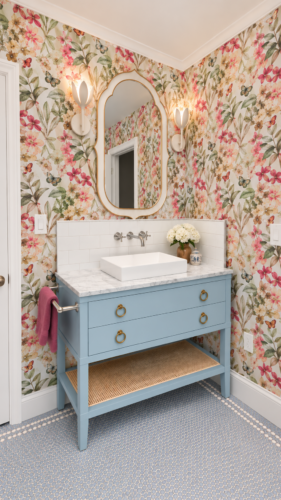
If there’s one room where I encourage homeowners to have a little fun, it’s the powder room.
It’s a small space, the door is usually closed, and you don’t spend hours in it every day. That makes it the perfect opportunity to use a wallpaper you might hesitate to put in a large living room.
In this bathroom, the colorful botanical wallpaper became the starting point for the room. The soft blue vanity, brass details and blue mosaic floor pull colors directly from the paper.
Instead of competing with one another, the elements feel connected.
This is also very much in line with 2026 design. Designers are reporting growing interest in wallpaper with botanical patterns, detailed ornamentation, small-scale florals and conversational prints—patterns that give you something new to notice when you look at them closely.
Designer Tip
When choosing a colorful wallpaper, don’t try to match every color in it.
Choose one or two secondary colors from the pattern and repeat those elsewhere in the room. That could be the vanity color, rug, lighting, tile or accessories.
The result feels coordinated rather than overly matched.
2. Blue Is Becoming a Beautif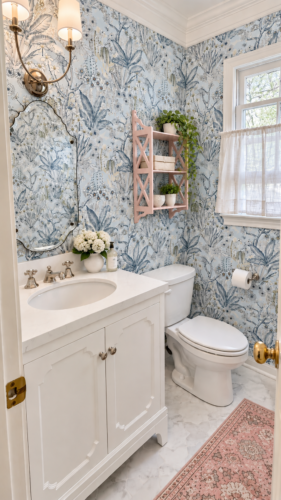 ul Backdrop for Pattern
One of the directions I’m particularly drawn to is the return of softer, more nuanced blues.
Rather than the cool gray-blue interiors we saw everywhere several years ago, today’s blues feel warmer and more layered.
In this powder room, the powder-blue botanical wallpaper gives the room plenty of pattern without making the small space feel heavy. Adding the blush pink shelf introduces another color without fighting the wallpaper.
This reflects a bigger shift happening in interiors. The movement away from all-white and gray spaces continues, while designers and homeowners are embracing warmer colors, blues, greens, natural materials and more individualized rooms.
The lesson for homeowners is important:
Wallpaper doesn’t necessarily make a small room look smaller.
When the colors are balanced and the pattern is appropriately scaled, covering all the walls can actually make a small room feel more complete and intentional.
3. Wallpaper Doesn’t Have to Cover the Whole Wall
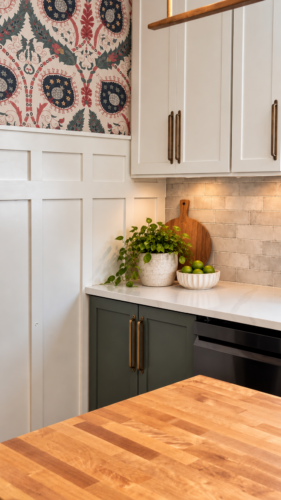
Wallpaper can also work beautifully as an accent within the architecture of a room.
In this kitchen, we used wallpaper above the white wall treatment rather than taking the pattern all the way to the floor.
The millwork gives the pattern a visual stopping point and allows us to introduce color without overwhelming the cabinetry, countertop and backsplash.
This is one of my favorite approaches for homeowners who love wallpaper but are nervous about committing to an entire room.
It also gives you an opportunity to connect spaces. A pattern containing colors already used elsewhere in the home can help a kitchen, breakfast room, mudroom or adjoining living area feel intentionally related.
And in 2026, we’re seeing wallpaper paired increasingly with architectural details rather than treated as an isolated decoration. Designers are coordinating wallpaper with painted trim and using it to emphasize the architecture of a space.
4. Wallpaper Can Turn an Architectural Detail Into a Focal Point
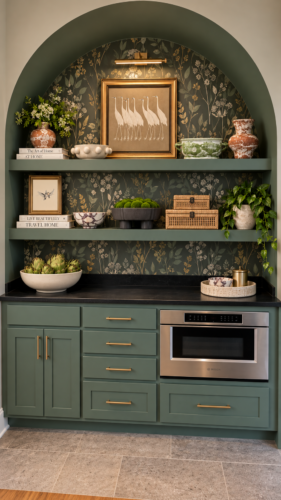
This may be my favorite example of how wallpaper can completely change a space.
Rather than wallpapering the entire kitchen, we used a dark botanical wallpaper inside this arched cabinetry niche.
The combination of the deep green cabinetry, floral pattern, black countertop and warm brass details creates a completely different experience from simply painting the back of the shelves.
The wallpaper emphasizes the shape of the arch and turns the entire area into a focal point.
This is where I think wallpaper is heading.
Instead of asking:
“Which wall should we wallpaper?”
I encourage homeowners to ask:
“Where could pattern create a moment?”
That might be inside an arch, behind built-in shelves, in a bar area, inside cabinetry, in a pantry or even on a ceiling.
Design forecasts for 2026 are pointing in exactly this direction. Wallpaper is increasingly being treated as an architectural detail, with designers extending it onto ceilings, inside cabinetry and into unexpected areas of the home.
The Biggest Wallpaper Trends We’re Seeing in 2026
So what should homeowners expect to see more of?
The biggest change isn’t one particular flower, color or pattern. It’s the idea that our homes can have more personality again.
For 2026, I’m watching botanical and nature-inspired patterns, sophisticated florals, darker and moodier papers, hand-painted and block-print looks, murals, stripes with a fresh interpretation, and wallpapers with visible or tactile texture.
Texture is particularly interesting. Houzz’s 2026 U.S. search data found searches for linen wallpaper increased 104%, while seagrass wallpaper increased 94%. That’s part of a much larger movement toward interiors that feel tactile, natural and less mass-produced.
We’re also seeing wallpaper leave the powder room. Designers report clients becoming increasingly comfortable using it in larger rooms such as bedrooms and living spaces, as well as on ceilings and other unexpected surfaces.
Will Today’s Wallpaper Look Dated?
This is probably the question I hear most often about wallpaper.
And it’s a fair one.
We’ve all walked into older homes and immediately known approximately when a wallpaper was installed.
My advice is not to choose wallpaper simply because it’s trending.
Choose a pattern that relates to the architecture of your home, the colors you already love and the feeling you want the room to have.
If your home leans traditional, a botanical, block print, stripe or heritage-inspired pattern can feel appropriate for decades.
If your style is quieter, consider grasscloth, linen-look wallpaper or a subtle tonal pattern.
And if you absolutely love color and pattern?
Use it.
One of the most encouraging shifts I’m seeing in design right now is homeowners becoming less concerned with creating a house that will appeal to everyone and more interested in creating a home that actually reflects the people living there.
Where Should You Use Wallpaper?
You don’t need a huge room—or a huge renovation—to introduce wallpaper.
Some of my favorite places to consider it are powder rooms, dining rooms, entryways, built-in niches, bars and coffee stations, above wainscoting or millwork, inside cabinetry, bedrooms and even ceilings.
The key is deciding what role you want the wallpaper to play.
Sometimes it should quietly add texture.
Sometimes it should connect the colors in a room.
And sometimes—as with the green arched niche—it should be the thing you notice the moment you walk into the space.
My Advice Before Ordering Wallpaper
Always get a sample.
Wallpaper can look dramatically different online than it does inside your home. Tape a large sample to the wall and look at it in the morning, afternoon and evening.
Then look at it next to your cabinetry, flooring, countertops and fabrics.
And if you’re renovating, choose the wallpaper early enough that it can influence the rest of your selections. Designers are increasingly treating wallpaper as one of the foundational elements of a room rather than something selected after everything else.
Most importantly, don’t be afraid of pattern simply because it’s a commitment.
A thoughtfully selected wallpaper can give a room something paint often can’t:
personality.
Ready to Add More Personality to Your Home?
At Next Kitchen and Bath, we believe the most memorable homes aren’t created by following every trend. They’re created by combining thoughtful design, function and details that feel personal to the homeowner.
Whether it’s a bold powder room, a wallpapered kitchen niche or a subtle pattern paired with custom cabinetry, those details are often what transform a renovation from simply “new” into something that feels truly designed.
Next Kitchen and Bath
Kitchen & Bath Design + Renovation
Athens, Georgia & surrounding areas


